

Frequently Asked Questions
Learn more about the spacecraft, the technology, and how this mission will begin humanity's first journey to another star.
The Fermi Explorer Mission has four primary objectives:
- Aim: To launch humanity's first spacecraft to another star. It should get at least 99% of the way to the nearest star system, Alpha Centauri (AC), within 80,000 years. The AC barycenter is currently 4.4 light-years away, so we are aiming to be within 0.044 light-years at the spacecraft’s closest pass by AC, which is within the Oort Cloud of AC. The aim is to minimize fuel and cost, and maximize payload, so we expect to aim for just before the intercept of Alpha Centauri with the ecliptic plane, which will occur in around 79,500 years. By the time that the Fermi Explorer arrives at AC, it will be just over 6 light years from the Sun since AC will then be moving away from us, so by that point, it will be more than 99% of the distance to AC.
- Payload: It should have at least a 1kg, 10cm x 10cm x 10cm payload. Some of the space will be reserved for donor, scientific, and artistic payloads as per the donor page and below.
- Schedule: It should launch before the end of 2029.
- Cost: It should cost less than $15M to design, build, launch, and operate. See the PSI paper for cost estimations.
The four primary objectives above are what we consider to be the minimum viable mission to another star. We do, however, have some other objectives that will not conflict with these:
- We will put a copy of the Golden Record and other similar information on the spacecraft.
- We will soon open up a three-month solicitation period for scientific instruments/items to be put on the Fermi Explorer Mission. Proposals should not conflict with the four primary objectives. Scientists should expect that for most sensors, we will likely not get data back from these instruments for around 80,000 years. Proposals will be selected by a panel of academics and space experts. See the questions further down for examples of scientific payloads that we expect to fly.
- We will soon open up a three-month solicitation period for artistic additions to be put on the Fermi Explorer Mission. Proposals should not conflict with the four primary objectives. Artists should expect that the art will not be seen again for around 80,000 years. Proposals will be selected by a panel (to be announced) of art and culture experts.
- The Apollo Moon landings took messages from the leaders of the countries of the world to the Moon. As an homage, we will give children in each country/region on Earth (as determined by IOC Olympic participation) the chance to choose 300 characters, in their own language, to put on the spacecraft. This will be coordinated by the national space agencies and the ministries of education of each country. We will announce the solicitation timeline and process in the coming months.
The mission is intended to make the idea of interstellar travel real, and to encourage more people to confront one of humanity’s biggest unanswered questions when we look beyond our planet: "Where is everybody?" (the Fermi Paradox)
The mission is named after the physicist Enrico Fermi, after whom the Fermi Paradox is named. The Fermi Paradox is the apparent inconsistency between the lack of conclusive evidence of extraterrestrial civilizations and the apparently high likelihood of their existence. One of the goals of the mission is to draw attention to the fact that it would be relatively easy to settle the galaxy in a few million years, not long in galactic timescales. Put simplistically, the Fermi Paradox implies one of three possibilities:
- Human-like intelligence is exceptionally rare in the universe.
- Human-like intelligence is not rare but doesn’t last very long for some reason.
- Human-like intelligence is common and lasts a long time, but cannot, or decides not to make itself known for some reason.
There is a concept called a Fermi Great Filter, which says that the Fermi Paradox is explained by the existence of a great filter that is extremely hard for life to pass through. Some good candidates that are behind us are the emergence of life or the evolution from single-celled to multicellular life. Fermi Great Filters in front of us could be that species can’t become multi-planetary or multi-stellar, or that species decide not to expand past their home star for some reason. By launching the Fermi Explorer mission, we can for the first time tick two possible Fermi Great Filters off the list:
- That it is impossible for an intelligent species to leave for their nearest stars
- That all intelligent species decide not to leave their home star for some reason
After the Fermi Explorer mission, we will have more confidence both that it is possible for intelligent species to leave for their nearest star in a way that isn’t resource prohibitive, and that there are at least some species that try to do it (namely us!). This has the effect of throwing the Fermi Paradox into even greater focus. It makes Hart's Fact A of the Hart-Tipler Conjecture even more surprising and confusing, and increases the likelihood that the solution to the Fermi Paradox is either that we are exceptionally rare, or that intelligent life is short-lived for some reason. Both of these should have consequences for how we live today. If intelligent life is very short lived, for some reason, then we should know and be prepared for that in the short term. And if we are exceptionally rare, then we need to take our role as stewards of consciousness very seriously, also in the immediate term.
Everyone has their own reasons for supporting the mission. For some, it is the human spirit of exploration and adventure: to take the first steps to extend consciousness to the stars. For others, it is to prove that we can rule out several Fermi Great Filters. Others view this as one of the most significant moments in the life of the universe. Five billion years from now, if and when we have settled the local group of galaxies, if you look back at the significant points in time, there will be a few very important points. The first life, the first multicellular life, the first multiplanetary exploration, and the first interstellar spacecraft will all be up there.
Alpha Centauri has the closest sun-like stars. Proxima Centauri, which is a red dwarf, is around 3% closer to the Sun than the pair of stars that make up Alpha Centauri, AC-A and AC-B. We chose Alpha Centauri since we believe that future humans and intelligences will be more interested in setting up a base there due to the fact that it emits around 2000 times more energy than Proxima Centauri. If we were to choose a red dwarf, then LSPM J2146+3813 is a better target than Proxima Centauri, as it requires a lot less propellant and cost to get there.
We chose Alpha Centauri over other sun-like stars since it is the closest and is currently moving towards us. Alpha Centauri also has the nice property of being one of the most prominent and beautifully located stars in the night sky. We hope that it will be inspiring that future generations can look up and know that humanity has sent something there. In fact, in Andean astronomy, Alpha Centauri has had special significance for hundreds of years as the eye of the Celestial Llama drinking in the Milky Way to prevent floods.
It should be noted that over many thousands of years, Alpha Centauri is moving northwest in the night sky and so we will not aim for its current location. We will aim for its position in about 80,000 years, which is in the part of the night sky where the constellation Cancer is now.
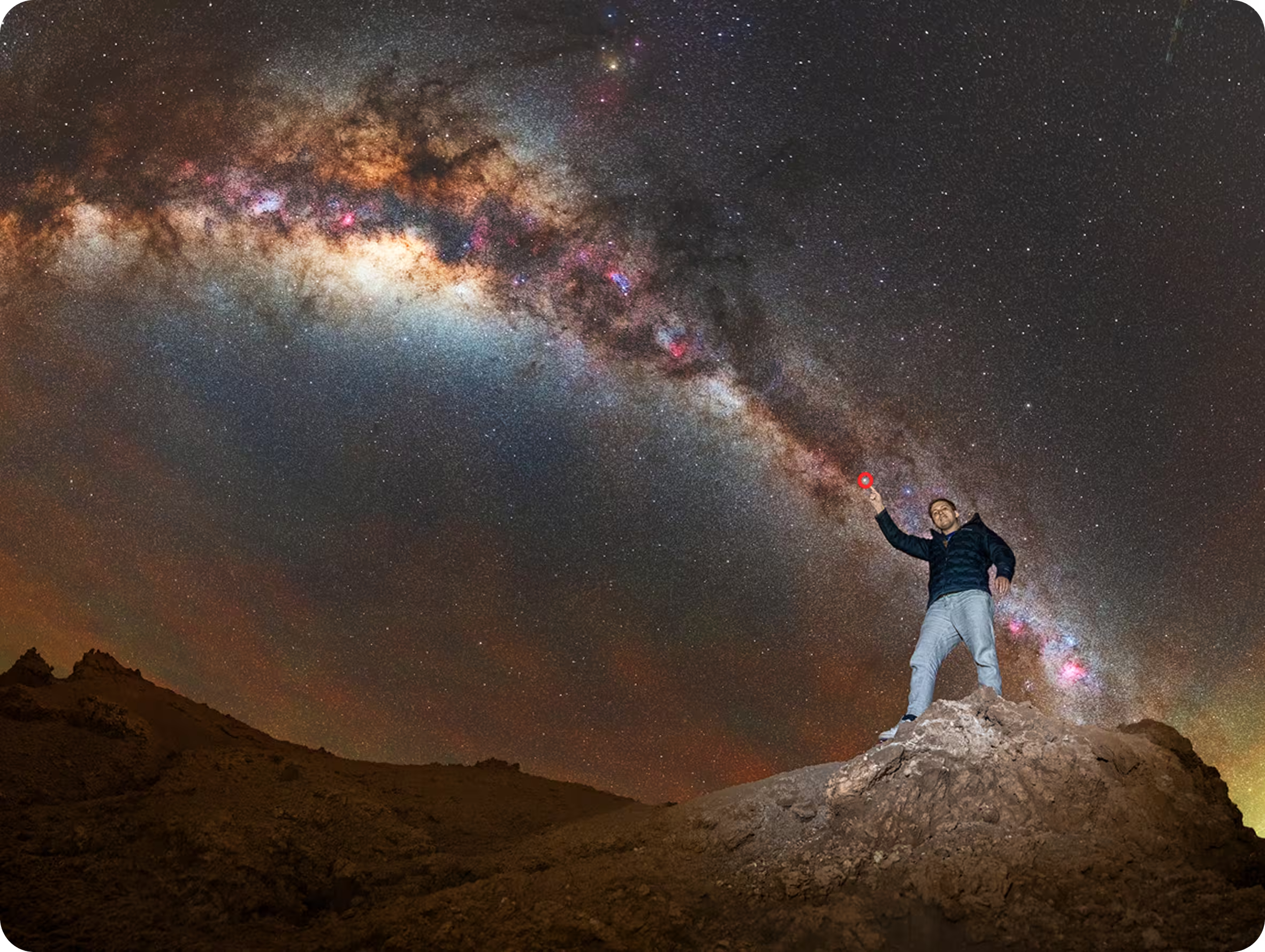
The image below shows Fermi Explorer Mission Co-founder & CEO, Philip Johnston, pointing at the exact star Alpha Centauri - the target of the mission. The inside of the red circle is approximately the area of the target that the Fermi Explorer spacecraft will aim for in the night sky, in order to be within 1% of the distance at closest pass. That is, the radius of this circle at a distance of 4.4 light-years is around 0.044 light years. The image was taken by astrophotographer, Alexis Trigo, in the Atacama Desert, Chile, with a 20-second exposure on July 14, 2026.
New spacecraft have historically had about a 50% likelihood of full success. Our opinion is that the likelihood is higher than that, since we are intending to use flight-proven technology wherever possible. However, if you are donating to the mission, then it would be wise to assume around a 50% chance of success.
No. There have been some attempts, such as the Breakthrough Starshot program, but none have ever launched anything. NASA has sent several spacecraft, such as the Voyager probes, into interstellar space, but none are aimed at any particular star. Just like the first 'interplanetary' spacecraft went between two planets, the first 'interstellar' spacecraft should also travel between two stars, not just to interstellar space.
Yes. We expect to be both the first to leave for another star and the slowest to arrive at another star. We think that the Fermi Explorer spacecraft could be viewed historically as one of the most important artifacts in the universe, as per the concept video.
While we expect most future spacecraft will want to make the journey faster than us, it is worth noting that any spacecraft that is optimizing for payload mass rather than speed will arrive after us. It's not difficult to imagine missions that might want to optimize for payload mass rather than speed, and so we expect there to be many spacecraft launching in the next few thousand years that will arrive after us.
In fact, we highly suspect that the first von Neumann style probes will take a similar path as us since some proposals for this are to send 1,000 humanoid robots and so they will want to optimize for mass rather than speed.
We will soon put the mission out for open tender to all the major satellite manufacturers, and we aim to open-source as much of the design as we can. The four primary objectives are considered non-negotiable. Everything else is negotiable. For example, the manufacturers can determine the power system, antenna strength, propulsion, mission profile, and whether to include gravity assists, etc. We anticipate that we can do the mission with around a 100-200 kg small solar-powered satellite with just electric propulsion, doing what we call a perihelion pump maneuver as described in the paper from PSI. We expect the mission will not have a large antenna for communication, and so we expect we will lose connectivity relatively quickly, and so much of the mission will be autonomous. It will be too small to track and will lose power once it leaves the solar system.
We are open to any design, but the favored design principle is to do as little R&D as possible and use flight-proven hardware as much as possible. Our main aim is to hit the four primary objectives, and we believe this gives us the best chance of doing that.
We already have one proposal from a US satellite bus manufacturer, that has completed more than 50 successful missions, for less than $15M to complete the mission. The board members, program manager, and advisors of the Fermi Explorer Mission will make the selection over the coming months, and we will consider track record, price, and schedule in making the award.
The mission planning was done by Fermi Explorer board members Adi Oltean and Ezra Feilden with significant input from the mission planning teams at Astro Digital and AstroForge. A new physical AI lab called Physical Super Intelligence (PSI), based in Cambridge, MA, devised the final 'perihelion pump maneuver' and we believe that this may be the first time that generative AI has independently devised a novel trajectory that will be flown on a real mission. Without the mission profile devised by PSI, the mission would be impossible under the budget constraints.
Target & Timeline: The mission targets an arrival at Alpha Centauri AB in roughly 77,500 years, passing within 2,600 AU of the system's barycenter. The ecliptic plane intercept is 79,500 years from now (worst case scenario shown in the video), and this specific 77,500-year arrival represents an optimal balance (the tilt-inclusive optimum) that accounts for the propellant costs required to steer the spacecraft's departure trajectory out of the ecliptic plane. Any shorter or longer travel time than 77,500 would require more fuel and delta-v, increasing the cost and/or reducing the payload.
Optimal Departure: A Geostationary Transfer Orbit (GTO) rideshare launch is highly preferable, requiring an initial Earth-escape delta-v of just 4.24 km/s. If we can only procure a launch to Low Earth Orbit (LEO) instead, the spacecraft must execute an Earth-escape spiral requiring 7.6 km/s of delta-v over approximately 1.5 years.
The Perihelion Pump: To account for the weak solar energy in deep space, and to take advantage of the Oberth effect, the vehicle executes retrograde arcs to drop its closest solar approach (perihelion) to 0.42 AU.
Heliocentric Delta-v: Prograde acceleration burns are concentrated at this 0.42 AU perihelion to maximize array power and Oberth effect, completing a 23.97 km/s delta-v phase over 12.0 years (with only 1.3 years of active thrust).
Final Cruise: The spacecraft will escape the solar system around the year 2043, entering an unpowered ballistic interstellar coast with a final heliocentric cruise velocity of 23.64 km/s.
Wet Mass & Propellant: Designed to be ultra-lightweight, the GTO-start vehicle requires a total launch mass of just 100 to 110 kg, of which roughly 64% is xenon propellant.
Propulsion & Operations: The spacecraft utilizes demonstrated gridded-ion thrusters (2400–2800 seconds Isp) and relies on highly automated operations to manage the 13-year powered flight phase, without the need for heavy antennas.
The board members and Co-founders of The Fermi Explorer Mission are Philip Johnston (CEO), Adi Oltean, and Ezra Feilden. The full-time program manager is Garrett Jameson. Rob Meyerson, Alex Wissner-Gross, and others are advisors.
The intent of the concept video is to show an optimistic outcome for humanity. It assumes that the Fermi Great Filter is behind us and that we will be the first to settle the universe. We estimate that with today's technology we could settle the nearest few thousand galaxies in about 5 billion years, and the video shows that path:
- Today: Mission planning and execution begin
- In 3 years: The mission launches
- In 50 years: The first spacecraft overtakes us
- In 1,000 years: Lots of spacecraft overtake us
- In 30,000 years: The first human spacecraft arrives at Alpha Centauri
- In 40,000 years: We start seeing spacecraft coming back towards the Sun as trade routes are established
- In 79,500 years: The Fermi Explorer arrives at Alpha Centauri, to a civilization that has already been there for around 50,000 years and had the time to develop O'Neill Rings and Dyson Swarms as shown in the concept video.
- In 80,000 years: We send the first interstellar probes beyond Alpha Centauri
- In 8,000,000 years: We will have settled the Milky Way galaxy and sent the first intergalactic probes
- In 1,000,000,000 years: We reach Andromeda, which we think we could do with today's technology for about $100M (Fermi Explorer's next mission!)
- In 5,000,000,000 years: We have settled the local cluster of a few thousand galaxies (still only around 30% of the age of the universe by then)
The video was produced by London-based studio 01c
It could, but our explicit request to future humans and intelligences is to not intercept it until it is close to its destination.
For possible sponsorship and partnerships, please reach out to info@fermiexplorer.org.
If you make a donation, you will not get your money back, regardless of whether the mission fails. If, for some reason, the mission does not launch, you will also not get your money back. Any money left over may be used for other attempts or for other missions. After the initial Alpha Centauri Mission, The Fermi Explorer Mission also intends to undertake other missions. For example, we estimate that for under $100M, we could send a spacecraft to the nearest galaxy, Andromeda, that could arrive within 1 billion years. If we can obtain the funds, we will make an attempt.
There will be many science payloads on the spacecraft. We will likely not get the results from most of the scientific payloads back for around 80,000 years, which in itself, can yield some fascinating results. Some science payloads that we are considering include:
- Corner-cube retroreflector array. A few grams of fused-silica corner cubes allow ground-based laser ranging to track the trajectory precisely for years to decades out (realistically from a few AU to tens of AU with large apertures), validating delta-v and targeting models. We may be able to arrange the cubes asymmetrically so that the glint pattern encodes spin rate, so that we can watch spin decay over time to observe attitude-dynamics.
- CR-39 / Lexan nuclear track detector stack. A fully passive plastic sheet that records the tracks of heavy cosmic-ray ions. Such detectors were flown on Apollo helmets and the LDEF. A laminated stack measuring few cm² and weighing tens of grams gives an integrated galactic cosmic ray spectrum over the entire mission, etched permanently into the material. It is similar to an archival version of a Geiger counter with no power needed.
- Thermoluminescent dosimeter crystals (TLD/OSL). LiF or Al₂O₃:C chips, milligrams each, that store total absorbed radiation dose in trapped electron states.
- Micrometeoroid witness plates / capture cell. Polished coupons of gold, aluminum, and fused silica with a thin-film top layer; every micron-scale impact leaves a crater whose morphology and residue chemistry identify the impactor. We can add a thin aerogel tile to capture interstellar dust grains intact, and over 80,000 years, the spacecraft sweeps a unique column of the local interstellar medium.
- Radioisotope clock set. Sealed milligram samples of isotopes with half-lives bracketing the mission (e.g. ⁶³Ni at 101 yr, ¹⁴C at 5,730 yr, ³⁶Cl at 301k yr). Whoever recovers it can independently date the mission elapsed time from the decay ratios — a self-authenticating chronometer that also doubles as a neutron-activation record.
- Aerogel Interstellar Dust Traps. Ultra-low-density silica aerogel tiles mounted on the leading edge of the spacecraft. Interstellar dust grains impacting at tens of kilometers per second embed themselves inside the fluffy gel, coming to a soft stop without being vaporized by heat.
- Passive detectability enhancer. A deployable radar corner reflector (thin metalized Mylar, tens of grams) plus a patterned high-contrast/retroreflective outer surface. The point is to make a spacecraft findable: by Earth telescopes early on, and by anything conducting a sky survey later.
We expect to receive many more exciting proposals once we open the three-month solicitation period. The details of this will be made available soon.
We have a media kit folder here. Members of the press and others are welcome to use these items freely with attribution.
If you are a member of the scientific community or the press, or if you are considering donating more than $100,000, then Philip Johnston, Co-founder & CEO, and Garrett Jameson, Program Manager, would be happy to jump on a call with you. Please message info@fermiexplorer.org.
Starcloud and the Fermi Explorer Mission are, and will remain, two completely distinct entities. The Starcloud founders have a common interest in interstellar space exploration and so created the Fermi Explorer Mission to pursue it. The board members, Philip Johnston (CEO), Adi Oltean, and Ezra Feilden work on the Fermi Explorer Mission voluntarily in their free time, and the day-to-day operations are handled by the full-time program manager, Garrett Jameson, who comes with almost a decade of mission execution experience with the US Air Force.
Almost all will be, but we will spend a small proportion on marketing, donor engagement, project management, website updates and other overheads.
The concept video, while broadly representative, has simplified certain things to make it easier to understand. None of the simplifications materially misrepresents the mission objectives; each is purely to make it easier to understand for a broad audience. For example, any spacecraft that is going to arrive at Alpha Centauri (AC) before us will not pass near us because other spacecraft will be on a different trajectory to intercept AC earlier, but this is unnecessarily complex to show. Another example is that it is more likely that as a civilization settles a galaxy, the stars dim rather than light up, since we may build Dyson swarms that will absorb the light. Also, as we speed up the video to get to Andromeda, the galaxies would actually be spinning quickly and heading towards each other. We know there are other inaccuracies, but none materially misrepresent the mission objectives.
Yes. It has the official name ‘The Fermi Explorer Mission’. Donors can find it on Fidelity Charitable and other similar DAF platforms with Tax EIN 39-3440942.
We have made it as accessible as possible to all. Donations starting at $1 get your name registered as a supporter of the mission.